

Fresh Roasted vs Store Bought Beans: 2026 Comparison
Table of Contents
- Fresh Roasted vs Store Bought Beans: The Core Differences
- How Long Do Coffee Beans Stay Fresh?
- The Coffee Roast Date: Your Most Reliable Freshness Signal
- How to Store Coffee Beans for Maximum Flavor
- Flavor, Aroma, and Bean Quality: What the Cup Actually Tells You
- Cost Per Cup: Fresh Roasted Coffee vs Supermarket Coffee
- How to Run a Side-by-Side Taste Test at Home
- Conclusion: Choosing the Right Beans for Your Routine
- Frequently Asked Questions
Last Updated: October 9, 2026
Fresh Roasted vs Store Bought Beans: The Core Differences
Fresh roasted vs store bought beans comes down to one variable: time. Coffee starts losing its best qualities the moment it leaves the roaster, and most supermarket bags sit for months before you brew them.
A best-by date tells you nothing about when the beans were roasted, it's a durability estimate, not a freshness record.
How Long Do Coffee Beans Stay Fresh?
The practical window for peak flavor is roughly 2 to 6 weeks after the roast date for most whole bean coffee. After that, the beans aren't unsafe, but the volatile compounds behind aroma and complexity fade.
That window shifts with roast level and storage: darker roasts decline faster, lighter roasts hold up longer, and ground coffee loses its best qualities far quicker than whole beans because more surface area is exposed to air.
The Post-Roast Resting Period
Freshly roasted beans need to rest before they brew well. Right after roasting, beans release carbon dioxide that interferes with even water saturation. For most brew methods, 3 to 7 days after the roast date hits the sweet spot; espresso often benefits from a longer rest.
Degassing and the Freshness Window
Degassing is the release of carbon dioxide trapped inside the bean during roasting, why a freshly opened bag puffs up and why a one-way valve matters. Once degassing slows, oxygen becomes the main enemy, oxidizing the oils and aromatic compounds that turn bright, sweet coffee into flat, papery, stale coffee. This is the core mechanism behind the entire fresh roasted vs store bought beans question: packaging and speed to market determine how much decline happens before the bag reaches your kitchen.
The Coffee Roast Date: Your Most Reliable Freshness Signal
The roast date is the single best indicator of coffee freshness you can find on a bag. It tells you exactly when the clock started, so you can judge how much of the flavor window remains. Mass-produced coffee rarely prints one, showing a best-by date or vague language instead, long shelf life is the goal, and a roast date would expose how long the product has actually been sitting.
Roast Date vs Best-By Date
These two dates measure completely different things, and confusing them is the most common buying error.
| Label | What It Tells You | Typical Use |
|---|---|---|
| Roast date | When the beans were roasted | Specialty and small-batch coffee |
| Best-by date | When the maker expects peak quality to end | Mass-produced, supermarket coffee |
| Packed-on date | When beans were bagged, not roasted | Some commercial brands |
A roast date lets you calculate freshness yourself; a best-by date asks you to trust a manufacturer's estimate, often set months out to accommodate slow retail turnover. Buy from roasters who print the roast date and roast to order.
How to Store Coffee Beans for Maximum Flavor
Storage is where the fresh roasted vs store bought beans question gets decided in your kitchen. The roast date sets the clock, but how you store the bag determines how fast that clock runs.
What Actually Ages Coffee
Four forces drive staling:
- Oxygen oxidizes the oils and aromatic compounds on and near the bean surface, the dominant cause of flat, papery flavor. It starts the moment the bag is opened and accelerates every time you reopen it.
- Moisture migrates into the bean and dulls the acids that read as brightness.
- Heat speeds up every chemical reaction, including oxidation. A cabinet above the oven is a bad home for beans.
Whole beans resist all four better than ground coffee because the surface area is dramatically smaller, which is why grinding right before brewing matters more than almost any storage upgrade.
A Practical Freshness Timeline
Treat freshness as a curve, not a switch. For a typical whole-bean medium roast stored in an airtight, opaque container at room temperature:
- Days 0-2 after roast: Too fresh for most brew methods. Heavy degassing disrupts water saturation, so extraction runs uneven and the cup tastes sharp or hollow.
- Days 3-7: The resting window closes and the cup comes into balance, the sweet spot for drip, pour-over, and French press.
- Days 7-14: Peak drinking for most beans. Aroma is generous, sweetness is intact, and the cup is easy to dial in.
Espresso shifts the curve later, often peaking around days 7-14, because the pressure-driven brew tolerates a longer rest. Darker roasts peak earlier and fall off faster.
Packaging: What the Bag Is Doing
Packaging is the most visible difference between fresh roasted and store bought beans. Here's what each format is engineered to do.
- One-way degassing valve: The standard for quality roasters. It lets carbon dioxide escape so the bag does not balloon, while blocking oxygen from entering.
- Nitrogen flushing: Common in mass-market bags. The air is replaced with an inert gas to slow oxidation before opening. It buys shelf time but cannot restore compounds never preserved at peak.
- Vacuum sealing: Removes most of the air and creates a hard brick. Effective at slowing staling, but the beans were likely roasted months earlier, so you are preserving an older starting point.
A vacuum-sealed or nitrogen-flushed bag roasted months ago is stable, not fresh.
Storage Rules That Move the Needle
- Keep beans whole until brewing; grind immediately before you brew.
- Use an airtight, opaque container with a tight seal or a one-way valve.
- Store in a cool, dark cabinet, not on top of the machine or beside the oven.
The freezer can work for longer-term storage if the beans go into a truly airtight container and you let them come fully to room temperature before opening, so condensation does not form. Done sloppily, freezing introduces moisture and off-flavors worse than simple staling.
How to Evaluate Freshness When You Buy
Since you cannot smell through the bag, use these signals at the shelf or on the product page:
- Look for a printed roast date, not just a best-by date, so you can calculate the timeline above yourself.
- Check for a one-way valve on the bag. Its presence usually signals a roaster who expects the beans to be brewed soon.
- Inspect whole beans if you can. Fresh beans look matte to slightly oily depending on roast level and smell sweet and complex when opened. Old beans look dry and dull and smell like almost nothing.
Flavor, Aroma, and Bean Quality: What the Cup Actually Tells You
Fresh beans taste sweeter, brighter, and more layered. Stale beans taste flat, papery, and sometimes cardboard-like, with bitterness that dominates instead of balancing.
The difference starts with bean quality. Specialty-grade beans grown at high elevation develop more density and complexity, showing up as distinct flavor notes: cocoa in a Brazilian bean, dried orange and berry in a Colombian, jasmine and strawberry in a Tanzanian.
Aroma is the tell. Most of what you perceive as "taste" is actually smell, driven by volatile compounds released when coffee is ground and brewed.
Cost Per Cup: Fresh Roasted Coffee vs Supermarket Coffee
Sticker price is the worst way to compare fresh roasted vs store bought beans. The bag price tells you almost nothing about what you pay per cup, because dose, waste, and how much coffee you brew to get a satisfying cup all vary.
Single Origin Favorites Sample Pack →
The Cost-Per-Cup Formula
Cost per cup = (bag price ÷ ounces in bag) × ounces per brew
Two variables drive the result: price per ounce of coffee, and ounces dosed per cup. A standard 12-ounce bag of whole beans brews roughly 24 to 30 cups at a typical dose, depending on brew method.
A Worked Comparison
Using realistic shelf and roaster prices, here is how the math shakes out per 12-ounce bag:
- Specialty fresh roasted, $23.99 per 12 oz: about $2.00 per ounce. At a 0.7-ounce dose, that is roughly $1.40 per cup. At a 0.5-ounce dose, closer to $1.00 per cup.
- Mid-tier supermarket whole bean, $12.99 per 12 oz: about $1.08 per ounce. At the same 0.7-ounce dose, roughly $0.76 per cup.
- Value supermarket ground, $8.99 per 12 oz: about $0.75 per ounce. At 0.7 ounces, roughly $0.52 per cup.
The gap looks large at the sticker, but it narrows once you account for the next two factors.
Waste and Dose Creep
Two hidden costs favor fresh beans:
- Dose creep. When a cup tastes flat, the common fix is to use more coffee. A stale bag that needs 0.9 ounces per cup instead of 0.7 erases much of its price advantage. At $1.08 per ounce, 0.9 ounces is about $0.97 per cup, not $0.76.
- Discarded coffee. A bulk bag you cannot finish before it stales means the last third is wasted. Throw away a quarter of a $12.99 bag and your effective cost per ounce rises by roughly a third.
Fresh beans hold their dose because the flavor is already there, so you are less likely to over-brew to compensate.
What You Are Paying For
Where fresh roasted coffee earns its price:
- Flavor and aroma: more complexity per cup, so you drink it black instead of loading it with additives that add their own cost.
- Consistency: a roast date and small-batch process mean less batch-to-batch variation, so you dial in a recipe once and it holds.
- Traceability: you can often identify the grower, region, and process behind the beans.
Where supermarket coffee wins:
- Convenience: available on any grocery run, no shipping wait.
- Price predictability: frequent sales and bulk discounts.
- Shelf life: designed to sit in your pantry for months.
Run Your Own Numbers
Before your next purchase, do this:
- Note the bag price and the net weight in ounces.
- Divide price by ounces to get cost per ounce.
- Weigh your typical dose in ounces for one cup.
- Multiply cost per ounce by dose to get cost per cup.
- Estimate how much of the bag you will realistically finish before it stales, and add that waste back in.
A higher sticker price can still win on cost per cup if you finish the bag and dose consistently.
For a full breakdown of what we offer, our Peru single origin and House Blend both run $23.99.

How to Run a Side-by-Side Taste Test at Home
A controlled taste test is the fastest way to answer the fresh roasted vs store bought beans question for yourself. You don't need special equipment, just discipline about keeping every other variable identical.


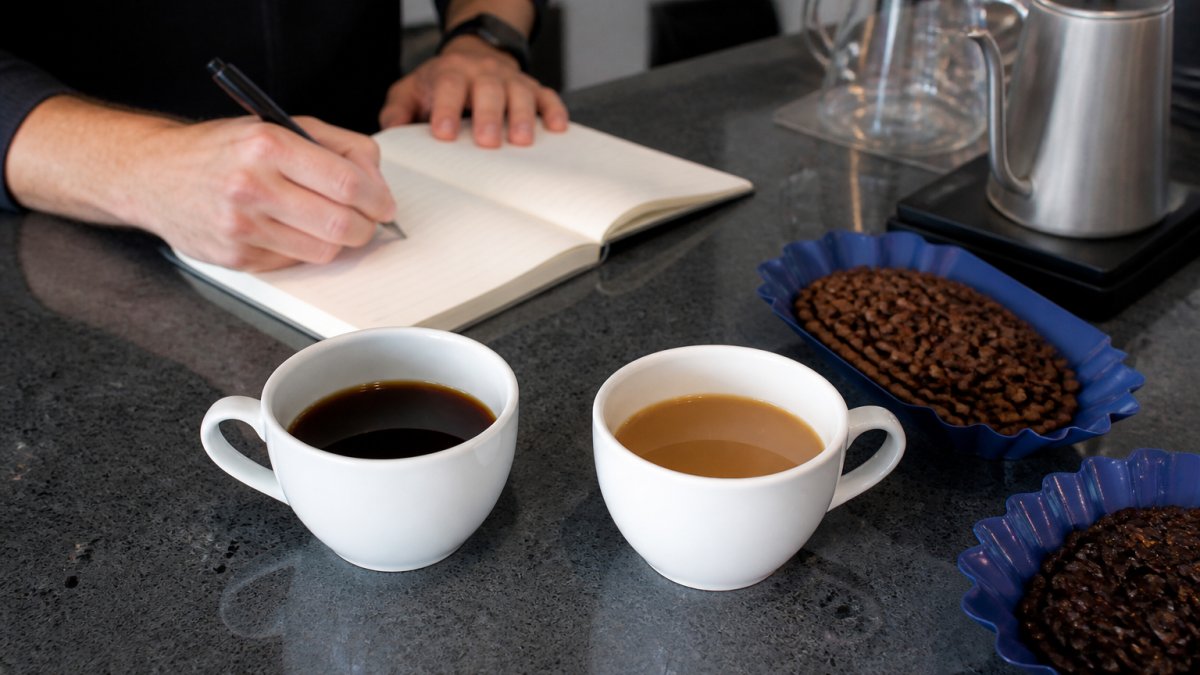
The Specialty Coffee Association's brewing standards offer a useful framework for keeping water temperature and ratio consistent. Follow these steps:
- Pick two coffees of similar roast level. Comparing a light roast to a dark roast tests roast, not freshness.
- Use the same grind size for both. Grind fresh, right before brewing, on the same grinder.
- Measure by weight, not scoops. Use the same coffee-to-water ratio for both cups, ideally around 1:16.
- Keep water temperature identical. Aim for the same temperature for both brews, within a degree or two.
- Brew both back to back. Don't let one cup sit while you brew the other.
- Taste blind if you can. Have someone else label the cups A and B so your expectations don't bias you.
- Note aroma first, then flavor. Write down what you smell before you sip, then describe acidity, sweetness, body, and finish.
Score each cup on a simple 1-5 scale across aroma, sweetness, acidity, body, and finish. Most people find the fresh cup wins on aroma and sweetness, while the older cup shows more bitterness and a shorter finish.
Conclusion: Choosing the Right Beans for Your Routine
The hardest part isn't understanding fresh roasted vs store bought beans. It's building a routine that keeps genuinely fresh coffee in your kitchen without adding friction to your mornings.
If you want maximum flavor, aroma, and control, buy whole beans with a printed roast date and grind them right before brewing.
Get started with Mike's Coffee and taste what a fresh roast does for your focus and your daily routine.
Frequently Asked Questions
Do fresh-roasted coffee beans taste better than store-bought beans?
Fresh-roasted beans typically deliver more aroma and flavor complexity because volatile compounds haven't degraded. Store-bought beans may sit for months before purchase, losing the oils and gases that carry tasting notes. The difference is most noticeable in drip coffee and pour-over, where subtle flavors aren't masked by milk or sugar. A side-by-side taste test using the same brew method is the clearest way to judge for yourself.
How long after roasting are coffee beans freshest?
Most coffee reaches peak flavor between 4 and 14 days after roasting. Beans rest for 24 to 72 hours after roasting to release carbon dioxide, then hit their best window. After about four weeks, flavor fades noticeably. Whole beans stay fresh longer than pre-ground coffee because less surface area is exposed to oxygen. Buying from a roaster that ships within days of roasting keeps you inside that window.
How can you tell if coffee beans are fresh?
Check the roast date first. If a bag only shows a best-by date, treat freshness as unknown. Fresh whole beans feel slightly oily or matte depending on roast level and smell strongly when the bag opens. When you pour hot water over freshly ground beans, they should bloom and bubble as trapped carbon dioxide releases. Flat, weak aromas and no bloom usually mean the beans are past their prime.
How should I store coffee beans to keep them fresh longer?
Keep whole beans in an airtight, opaque container at room temperature, away from light, heat, and moisture. Buy only what you'll use in two to four weeks. Avoid the refrigerator because condensation cycles damage the beans; the freezer works only if you seal beans in an airtight bag and thaw them fully before grinding. Grinding right before brewing preserves more aroma than any storage trick.
Are freshly roasted coffee beans worth the extra cost?
A 12-ounce bag of fresh specialty coffee often costs $15 to $25, while supermarket coffee can run $8 to $12 for the same size. Per cup, the difference is usually 30 to 60 cents. If you drink one cup daily, that's roughly $10 to $18 more per month. For drinkers who value flavor and aroma, the upgrade is often worth it; for those who add milk and sugar, the gap matters less.