

Fresh Roasted Coffee vs Store Bought: 2026 Comparison
Table of Contents
- Fresh Roasted Coffee vs Store Bought: The Core Differences
- What Fresh-Roasted Coffee Means
- How Store-Bought Coffee Is Processed and Sold
- How Long Coffee Beans Stay Fresh: The Practical Freshness Window
- Coffee Roast Date: How to Read Packaging and Spot Stale Coffee
- Fresh Coffee Beans vs Pre-Ground Coffee: Grinding, Oxidation, and Flavor
- How to Store Coffee Beans for Maximum Freshness
- Cost and Convenience: Fresh Roasted Coffee vs Store Bought
- Conclusion: Choosing What Fuels Your Daily Focus
- Frequently Asked Questions
Last Updated: October 9, 2026
Fresh Roasted Coffee vs Store Bought: The Core Differences
Fresh roasted coffee vs store bought comes down to one variable: time since roasting. Fresh-roasted coffee is roasted to order and reaches you within days; store-bought coffee can sit in a warehouse and on a shelf for months.
At Mike's Coffee, we roast in small batches to order. Below, we break down processing, packaging, storage, and cost so you can decide what belongs in your kitchen.
What Fresh-Roasted Coffee Means
Fresh-roasted coffee means the beans were roasted close to the date you buy them, not months earlier. The clock on flavor starts when the roast finishes.
A local roaster or a roaster that ships direct typically roasts in small batches and prints a roast date on the bag.
The trade-off is logistics: fresh-roasted coffee costs more per bag and requires planning, since you buy on a roast schedule rather than grabbing a can during your weekly grocery run.
How Store-Bought Coffee Is Processed and Sold
Store-bought coffee is built for shelf life, not peak flavor. Commercial roasters roast in very large batches, then package to survive months of distribution.
That process usually involves one or more of the following:
- Large-batch roasting with less control over the roast curve
- Vacuum packaging or sealed packaging to limit oxygen exposure
- Nitrogen flushing to push out oxygen before sealing
None of these steps are dishonest. They solve a real problem: getting coffee to millions of stores without it going rancid.
U.S. Department of Agriculture food storage guidance notes that proper storage slows the staling process but cannot reverse it.
How Long Coffee Beans Stay Fresh: The Practical Freshness Window
Coffee beans stay fresh for roughly two to four weeks after the roast date when stored properly, though the peak window is narrower. Whole beans hold quality longer than pre-ground because less surface area is exposed to air.
A practical freshness window looks like this:
- Days 1-3 after roasting: Resting period; beans degas heavily and brew inconsistently
- Days 4-14: Peak freshness for most brewing methods
- Days 15-30: Still good, with a gradual fade in aroma
This is why roast-to-order coffee matters: buy beans roasted the same week you receive them, and you control where in that window you start brewing.
Peak Freshness: Days After Roasting vs Months on the Shelf
Days after roasting is the metric that separates fresh-roasted coffee from most store-bought options. A bag roasted five days ago and a can roasted five months ago look identical on the shelf but brew very differently.
The months-on-the-shelf problem compounds: oxygen exposure, temperature swings during shipping, and warehouse time all chip away at the volatile compounds that create aroma.
Coffee Roast Date: How to Read Packaging and Spot Stale Coffee
The roast date is the fastest way to judge freshness. If a bag doesn't show one, that's information too, and it usually isn't good.
Here's how to read packaging like a buyer who knows what they're looking for:
- Roast date printed clearly: Best case. Buy within a few weeks of it.
- "Best by" date only: Work backward; the roast likely happened months earlier.
- No date at all: Assume the worst and treat it as a red flag.
Vacuum Packaging, One-Way Valves, and Oxygen Exposure
One-way valves are the small circular valves on better coffee bags that let carbon dioxide escape while keeping oxygen out. Freshly roasted coffee releases CO2 for days, and a sealed bag with no valve can balloon or trap stale air.
Vacuum packaging removes air entirely, extending shelf life but doing little for flavor once the coffee is already old. The valve signals the roaster expects the coffee to be brewed soon.
Fresh Coffee Beans vs Pre-Ground Coffee: Grinding, Oxidation, and Flavor
Fresh coffee beans versus pre-ground coffee is a freshness question first, convenience second. Grinding exposes the bean's interior to oxygen, starting the staling clock immediately.
Whole beans keep their aroma locked inside until you grind them.
Grind size also matters for extraction. A grind matched to your brewing method controls how evenly water pulls flavor from the grounds, and pre-ground coffee locks you into one grind size.
| Factor | Fresh-Roasted Whole Beans | Store-Bought Pre-Ground |
|---|---|---|
| Time since roast | Days | Often months |
| Oxygen exposure | Low until ground | High, starts at grinding |
| Aroma retention | High | Low to moderate |
| Grind flexibility | Full control | Fixed |
| Convenience | Requires grinding | Ready to brew |
| Best for | Flavor-focused brewers | Speed and ease |
How to Store Coffee Beans for Maximum Freshness
Storing coffee beans well means limiting three things: oxygen, moisture, and heat. Get those under control and you extend the peak freshness window by days or weeks. But storage is only half the job, a perfect container cannot rescue coffee that was already old when you bought it.
Reading the bag before you worry about the container
Packaging tells you more about freshness than any storage gadget. What the common labels mean:
Single Origin Favorites Sample Pack →
- Roast date printed clearly: The most useful number on the bag. Buy within a few weeks of it and store it well.
- "Best by" date only: A quality guarantee from the seller, not a roast date. Work backward and assume the roast happened well before.
- No date at all: A red flag. You have no way to judge freshness.
U.S. Department of Agriculture food storage guidance notes that proper storage slows the staling process but cannot reverse it. Once coffee has oxidized, no packaging trick brings the aroma back.
The freshness window shifts with roast level and brew method
A single number for "how long coffee stays fresh" is misleading, because the ideal window depends on the roast and brew method. Most practitioners find this pattern holds:
- Days 1-3 after roasting: Resting period. Beans degas heavily and brew inconsistently, especially for espresso, which needs the CO2 to settle before it extracts evenly.
- Days 4-14: Peak freshness for most brewing methods. This is the window to aim for.
- Days 15-30: Still good, with a gradual fade in aroma. Drip and immersion methods tolerate this stretch better than espresso.
Two adjustments matter. Darker roasts peak earlier and fade faster than lighter roasts, because roasting has already driven off more volatile compounds. Espresso wants a short rest and a narrow window, while French press or cold brew still tastes acceptable from beans a few weeks old.
A storage routine that protects the window
A simple routine works for most home setups:
- Transfer beans to an airtight, opaque container
- Keep the container in a cool, dark cabinet
- Store whole beans, not pre-ground, whenever possible
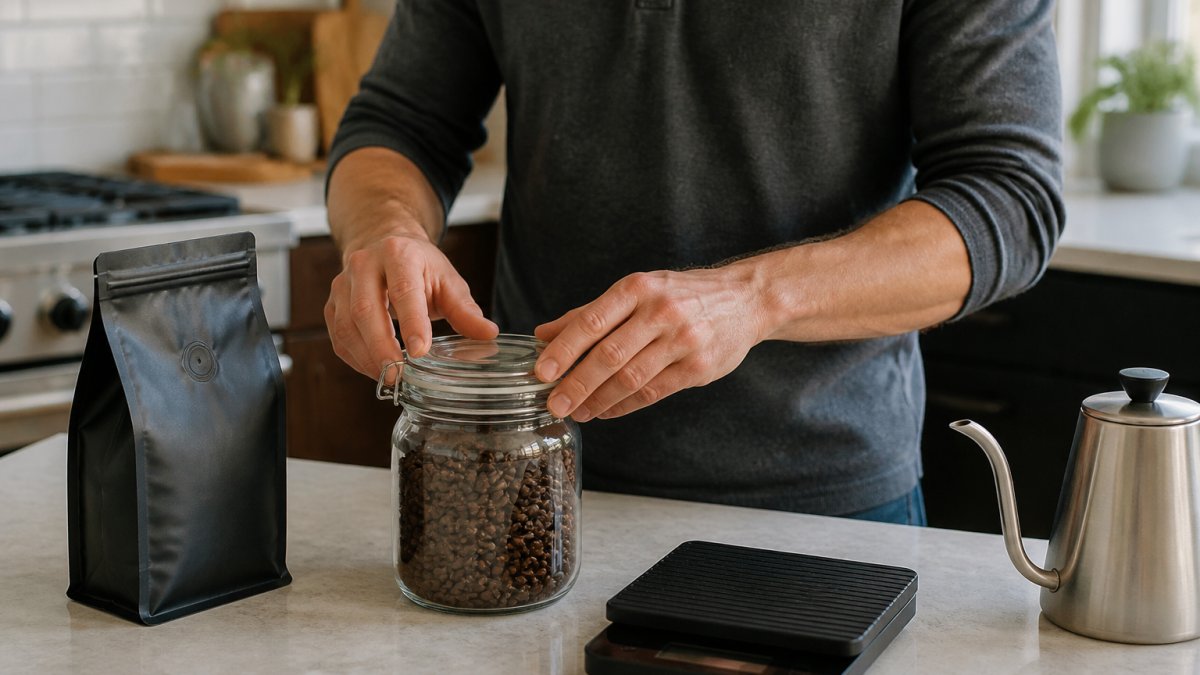
If you buy from a local roaster or one that ships to order, ask about the roast schedule. Buying smaller amounts more often beats stocking up and letting bags sit.
What storage cannot fix
Storage slows decline; it does not reset the clock. A bag roasted five days ago and a can roasted five months ago look identical on the shelf but brew very differently, and no container changes that. The most effective freshness decision is at the point of purchase, choosing a bag with a recent roast date, not at the counter afterward.
Cost and Convenience: Fresh Roasted Coffee vs Store Bought
Fresh roasted coffee vs store bought is also a cost and convenience decision, and the sticker price and per-cup price tell different stories. Store-bought wins on the number printed on the bag and on grab-and-go convenience. Fresh-roasted coffee costs more up front and requires planning around a roast schedule or subscription. What most comparisons skip is what happens after you divide by the number of cups.
Doing the per-cup math honestly
A standard 12-ounce bag of whole-bean coffee holds roughly 340 grams. A typical drip or pour-over dose runs about 15 to 18 grams per 8- to 10-ounce cup, so a 12-ounce bag yields between 19 and 22 cups. A supermarket can and a specialty bag can look far apart on the shelf, but once you divide by cups, the gap is usually measured in cents, not dollars.
Two variables change that math more than the bag price does:
- Dose size. If you brew 20-gram cups instead of 15-gram cups, you burn through a bag about 25 percent faster, and the per-cup cost rises accordingly.
- Waste. Stale coffee gets dumped. A bag you finish tastes better than a bag you abandon half-full, and abandoned coffee is the most expensive coffee you buy.
What you actually pay for beyond the beans
Fresh-roasted coffee often carries a hidden equipment cost. Whole beans require a grinder: a blade grinder is cheap but produces an uneven particle size that hurts extraction, while a burr grinder costs more but gives the consistent grind that makes fresh beans worth buying.
Storage is a smaller line item but worth naming: an airtight, opaque container costs little and protects the beans you paid a premium for. Skip it and you are paying specialty prices for coffee that stales on your counter.
Convenience and accessibility, stated fairly
Store-bought coffee is available on every grocery run, in every size, at every price point, with no planning, a genuine advantage, not a consolation prize. Fresh-roasted coffee asks you to plan: order before you run out, account for shipping time, and time your purchase so the beans arrive near the start of their peak window.
The convenience gap has narrowed. Roasters that ship direct, including our own sample packs, let you try several origins before committing to a full bag. Our Single Origin Favorites Sample Pack includes six 2-ounce packs for $24.99, and our Best Sellers Sample Pack covers six popular blends at the same price. Single origins like our Peru or blends like our House Blend run $23.99.


A fair way to judge whether the premium is worth it
Ask three questions before you decide:
- How many cups a day do you drink? Heavy drinkers close the per-cup gap fastest because the fixed cost of a grinder spreads across more cups.
- Will you actually finish the bag? If a bag lasts you two months, fresh-roasted coffee loses its advantage before you reach the bottom.
- Do you have a grinder and a few minutes in the morning? If not, the honest recommendation is pre-ground from a roaster that grinds to order, not whole beans you cannot use well.
Fresh-roasted coffee is not automatically the better buy for everyone. It is the better buy when you drink enough to finish a bag inside its peak window, have the equipment to brew it well, and value flavor and aroma enough to pay a small per-cup premium. If any condition is missing, store-bought coffee is a reasonable choice.
Conclusion: Choosing What Fuels Your Daily Focus
The choice between fresh roasted coffee and store-bought coffee is really about what you want from your morning cup. If speed and shelf stability matter most, store-bought does its job.
At Mike's Coffee, we roast specialty-grade beans from high-elevation estates in small batches to order, using precision thermal mapping to protect flavor and aroma. Our sample packs and single-origin selections make it easy to find your match without overcommitting.
Frequently Asked Questions
Is fresh roasted coffee better than store-bought?
Fresh roasted coffee typically delivers more flavor and aroma because it is used closer to its roast date. Store-bought coffee often sits for months, during which oxidation and degassing reduce volatile compounds. A fair comparison brews both the same way and grinds just before brewing. If you value bold flavor and rich aroma, fresh roasted coffee gives you a clear edge, especially when you buy from a local roaster or a roasted-to-order service.
How long do coffee beans stay fresh after roasting?
Whole beans hit peak freshness about 3 to 14 days after roasting and stay good for roughly 2 to 4 weeks if stored in an airtight container away from light, heat, and moisture. After that, flavor loss accelerates. Pre-ground coffee declines faster, often within days, because more surface area is exposed to oxygen. A roast date on the bag is your best guide to how long coffee beans stay fresh.
How can you tell if store-bought coffee beans are fresh?
Check the bag for a roast date rather than a best-by date. If there is no roast date, look for a one-way valve and a sealed packaging design that limits oxygen exposure. Whole beans should smell aromatic when you open the bag; a dull or flat scent suggests stale coffee. Buying from a local roaster or a roasted-to-order service is the most reliable way to know your coffee is fresh.
How should you store coffee beans to keep them fresh?
Keep whole beans in an airtight container in a cool, dark place, away from the stove, oven, or sunny windows. Avoid the fridge because moisture and odors can migrate into the beans. For longer storage, freeze in a sealed bag and scoop out what you need before grinding. Always grind just before brewing, and buy only as much as you will use within a few weeks to protect flavor and aroma.
Does freshly roasted coffee taste different from pre-packaged coffee?
Yes. Freshly roasted coffee tends to have brighter acidity, clearer origin notes, and a richer aroma. Pre-packaged coffee that has spent months on the shelf often tastes flat or bitter because oxidation and carbon dioxide loss strip away volatile compounds. A controlled taste comparison using the same brew method, grind size, and water temperature usually shows a noticeable difference in cup quality.